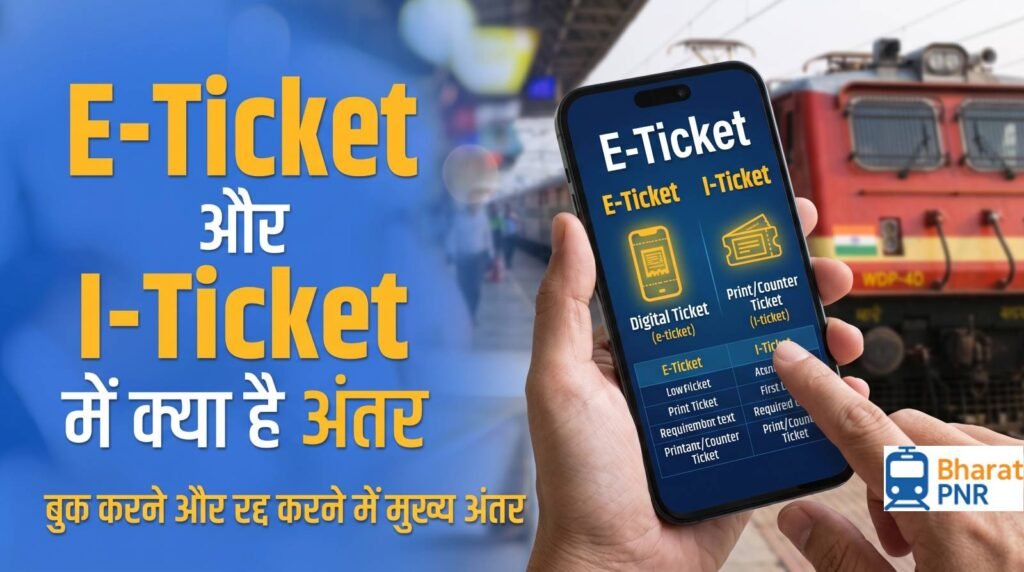
E-Ticket vs I-Ticket: What Is the Difference and Which One Is Better?
When booking a train ticket in India, you may come across terms like E-Ticket and I-Ticket. Both are related to railway reservations, but they work differently. For many passengers, the difference can be confusing, especially if they are booking a train ticket online for the first time.
An E-Ticket is the most common option today. It can be booked online and is provided electronically, so passengers do not normally need to collect a physical ticket from the railway station. An I-Ticket, on the other hand, was designed as an online booking option where a physical railway ticket was delivered to the passenger.
With the growth of digital railway services, E-Tickets have become much more convenient for most passengers. However, understanding the difference between these two types of tickets is still useful, especially when reading older railway information or comparing different booking options.
In this guide, we will explain what an E-Ticket and I-Ticket are, how they differ, their advantages and disadvantages, and which option is better for different types of passengers.
If you have already booked a train ticket and want to check whether it is confirmed, RAC or waitlisted, you can use our PNR Status Check tool.
What Is an E-Ticket?
An E-Ticket is an electronic railway ticket booked online through an authorised railway ticketing service.
When you book an E-Ticket, you enter your journey and passenger details online and make the required payment. After the booking is successful, you receive the ticket details electronically.
You can normally show the required ticket information on your mobile phone or carry a suitable electronic or printed copy as permitted by the railway rules.
The main advantage of an E-Ticket is that you do not have to wait for a physical ticket to be delivered to your home.
What Is an I-Ticket?
An I-Ticket was an online railway ticket booking facility where the passenger booked the ticket online but received a physical ticket through delivery.
In simple words, the booking was done online, but the actual ticket was a physical railway ticket.
This made I-Tickets different from E-Tickets. With an E-Ticket, the passenger could access the ticket electronically, while an I-Ticket involved receiving the physical ticket.
I-Tickets were more relevant in the earlier stages of online railway ticketing. With the widespread adoption of digital tickets, E-Tickets became much more practical for everyday train travel.
E-Ticket vs I-Ticket: Main Difference
The easiest way to understand the difference is to look at how the ticket is received and used.
| Feature | E-Ticket | I-Ticket |
|---|---|---|
| Booking | Booked online | Booked online |
| Ticket format | Electronic | Physical |
| Delivery | Digital | Physical delivery |
| Station collection | Normally not required | Physical ticket was delivered |
| Convenience | Very convenient | Less convenient |
| Common today | Widely used | Mostly historical/legacy option |
How Does an E-Ticket Work?
Booking an E-Ticket is a straightforward process.
- Log in to an authorised railway ticket booking service.
- Enter your source and destination stations.
- Select your journey date.
- Choose an available train.
- Select the travel class.
- Enter passenger details.
- Make the payment.
- Receive the booking confirmation and PNR details.
Once your ticket is booked, you can keep the ticket information on your phone or access it through the applicable railway booking account.
Before travelling, it is a good idea to check your booking status. You can use our PNR Status Check tool to see the latest status of your reservation.
Advantages of an E-Ticket
E-Tickets have several advantages, which is why they are preferred by most passengers.
1. No Physical Delivery
You do not normally have to wait for a physical ticket to arrive. Your booking information is available electronically.
2. Easy to Carry
You can keep your ticket information on your smartphone, making it much easier to manage during travel.
3. Quick Booking
You can book your ticket online without visiting a railway reservation counter.
4. Easy Access to PNR Details
Your PNR is available with the booking information, making it easier to check reservation status before the journey.
5. Useful for Last-Minute Planning
When online reservations are available, an E-Ticket can be booked quickly without waiting for physical delivery.
What Are the Disadvantages of an E-Ticket?
E-Tickets are convenient, but there are a few practical things passengers should remember.
- You should keep access to your valid ticket details during the journey.
- Your phone should ideally have enough battery if you are relying on a mobile ticket.
- You may need to show valid identification along with your ticket as required.
- You should make sure the passenger details entered during booking are correct.
These are generally easy to manage, which is why digital tickets have become the preferred choice for many travellers.
Advantages of an I-Ticket
The main advantage of an I-Ticket was that passengers received a physical railway ticket.
This could be useful for passengers who preferred having a physical ticket instead of relying on electronic information.
However, the physical delivery requirement also made the process slower and less flexible compared with an E-Ticket.
Disadvantages of an I-Ticket
The biggest problem with an I-Ticket was the requirement for physical delivery.
- The ticket had to be delivered physically.
- Booking could not be treated as completely paperless.
- Passengers had to make sure the physical ticket was available before travelling.
- It was less convenient for people making travel plans at short notice.
These limitations made E-Tickets more attractive as digital railway services became more common.
Which Is Better: E-Ticket or I-Ticket?
For most modern railway passengers, an E-Ticket is the more convenient option.
The biggest reason is simplicity. You can book online, receive the ticket electronically and keep the necessary information on your phone. There is no need to wait for physical ticket delivery.
An E-Ticket is particularly useful for passengers who are comfortable using smartphones and online payment methods.
If you are planning a long-distance journey, it is also convenient to check your PNR status online before leaving for the station.
Is an E-Ticket Valid for Train Travel?
Yes, a valid E-Ticket can be used for train travel according to the applicable Indian Railways rules.
Passengers should keep the required ticket information available and carry an accepted identity document when required.
During ticket checking, the railway staff may verify the passenger’s booking and identity details.
What Is a PNR Number and Why Is It Important?
A PNR, or Passenger Name Record, is the reference number associated with your railway reservation.
It is useful for checking the current status of your booking. Your status may change from waitlisted to RAC or confirmed depending on cancellations and other factors.
For example, if you booked a ticket several weeks before your journey, it is a good idea to check the PNR again closer to the travel date.
You can easily check your booking using our PNR Status Check tool.
E-Ticket vs I-Ticket for Family Travel
For families, digital tickets can make travel planning easier. Instead of keeping several physical tickets, the booking information can be managed electronically.
However, make sure that the passenger names, ages and other details are entered correctly during booking.
It is also useful to keep the booking information accessible to the person responsible for managing the family’s travel documents.
E-Ticket vs I-Ticket for Senior Citizens
Senior citizens who are comfortable using smartphones may find E-Tickets very convenient. Family members can also help with online booking and keep the ticket information available on a phone.
For passengers who are not comfortable with digital services, booking through a railway reservation counter may still be a more comfortable option.
What Should You Carry While Travelling With an E-Ticket?
Before leaving for the railway station, make sure you have the following:
- Valid E-Ticket or booking information
- PNR number
- Accepted identity document
- Charged mobile phone
- Important journey details
It is also a good idea to check the final reservation status before starting your journey.
Common Mistakes to Avoid When Booking an E-Ticket
- Entering the wrong passenger name or age.
- Selecting the wrong source or destination station.
- Choosing the wrong journey date.
- Not checking the train number before payment.
- Ignoring the ticket status after booking.
- Not carrying the required identification document.
- Waiting until the last moment to check your PNR status.
A few minutes of checking before the journey can help avoid unnecessary problems at the station.
Frequently Asked Questions About E-Ticket and I-Ticket
1. What is an E-Ticket?
An E-Ticket is an electronic railway ticket booked online. The passenger receives the booking information digitally instead of waiting for a physical ticket.
2. What is an I-Ticket?
An I-Ticket was an online booking facility in which the passenger booked the ticket online but received a physical railway ticket through delivery.
3. What is the main difference between E-Ticket and I-Ticket?
The main difference is the ticket format. An E-Ticket is electronic, while an I-Ticket was a physical ticket booked through an online process.
4. Which is better, E-Ticket or I-Ticket?
For most passengers, an E-Ticket is more convenient because it can be accessed digitally and does not require physical ticket delivery.
5. Do I need to print my E-Ticket?
Passengers generally do not need to carry a printed copy when the valid ticket can be presented through the permitted digital method. However, always follow the latest railway instructions for your booking.
6. Do I need an ID proof with an E-Ticket?
Passengers should carry an accepted identity document as required by the railway ticketing rules. The passenger’s identity may be checked during the journey.
7. Can I check my E-Ticket status online?
Yes. You can check your current train reservation status using your PNR. Our PNR Status Check tool can be used for this purpose.
8. Can an E-Ticket be cancelled?
Eligible E-Tickets can be cancelled according to the applicable railway cancellation rules. Refunds and cancellation charges depend on the ticket status and timing of cancellation.
9. Is an E-Ticket safe to use?
Yes, when booked through an authorised railway ticketing service, an E-Ticket is a convenient and widely used way to travel by train.
10. Can I travel with an E-Ticket if my phone battery is low?
You should keep your phone sufficiently charged so that you can access your ticket when required. Carrying a power bank can be useful during long journeys.
Final Words
E-Ticket and I-Ticket were created to make railway ticket booking easier, but they work in different ways. An E-Ticket is digital, while an I-Ticket involved online booking followed by physical ticket delivery.
For most passengers today, the E-Ticket is the simpler and more convenient choice. It saves time, avoids physical delivery and makes it easier to manage your railway booking from your phone.
If you have already booked a train ticket, remember to check your PNR status before travelling. You can use our PNR Status Check tool to check whether your ticket is confirmed, RAC or waitlisted.
Note: Indian Railways ticketing procedures, facilities and rules can change over time. Always check the latest official railway rules and conditions before booking or travelling.