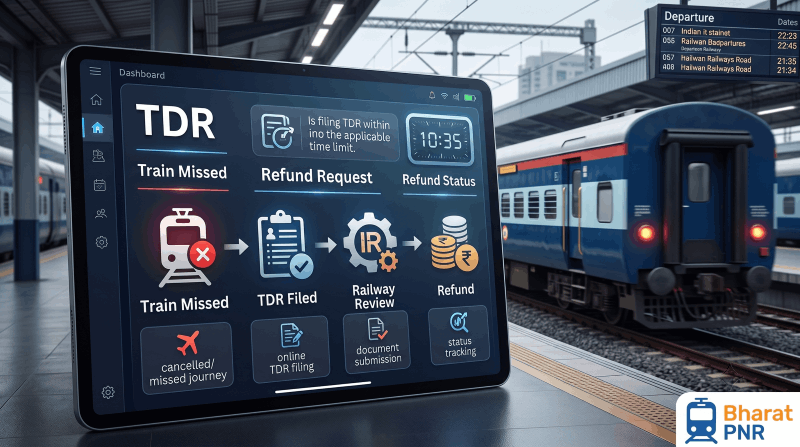
Train Missed? TDR Filing Process & Refund Rules Explained
Missing a train can be frustrating, especially when you already have a confirmed ticket. The first question that usually comes to mind is, “Can I get my money back?”
The answer depends on why you missed the train. If you reached the station late and the train had already left, getting a refund can be difficult. But if the train was heavily delayed, diverted, or you missed a connecting train because of a railway delay, you may be able to claim a refund under the applicable railway rules.
Before checking the refund process, you can also check your ticket details using our PNR Status Check tool.
In this article, we will explain what TDR is, when you can file it, how the TDR filing process works, and what you should do if you miss your train.
What Is TDR?
TDR stands for Ticket Deposit Receipt. In simple words, it is a way to request a railway ticket refund when normal ticket cancellation is not possible or when your situation falls under a specific refund rule.
For online tickets booked through IRCTC, passengers can file a TDR for certain eligible reasons. However, filing a TDR does not mean that the refund will automatically be approved. The claim is checked according to the applicable Indian Railways refund rules.
This is why choosing the correct reason while filing the TDR is very important.
I Missed My Train. Can I Get a Refund?
This is probably the first thing most passengers want to know.
If you missed your train because you reached the station late, a refund is generally not available just because you could not board the train. For example, if your train was scheduled at 8:00 AM and you reached the station at 8:30 AM after the train had already departed, the situation is normally treated differently from a railway-related delay.
However, there are situations where a passenger may be eligible for a refund. These can include cases where:
- The train is more than three hours late and you decide not to travel.
- The train has been diverted and you do not want to travel.
- The train does not pass through your boarding station because of diversion.
- You miss a connecting train because the first train was delayed.
- Your situation falls under another specific refund provision of Indian Railways.
So, before filing a TDR, it is important to understand the actual reason for your missed journey.
What If I Reached Late and the Train Left?
Let’s take a simple example.
Your train is scheduled to leave at 7:00 PM. Due to traffic or some personal reason, you reach the station at 7:20 PM. The train has already left.
In this case, the train was not late and the railway did not cause you to miss the journey. Therefore, you should not expect a refund simply because you could not catch the train.
If you know that you are going to miss your train, check the applicable cancellation rules as early as possible. Waiting until after the train has departed can make the refund situation more difficult.
Also, do not select an incorrect TDR reason just to try to get a refund. The claim can be checked by the railway authorities and may be rejected if the reason does not match the actual circumstances.
What If the Train Is More Than 3 Hours Late?
This is one of the important situations where passengers may be eligible for a full refund.
If your train is running more than three hours late at your boarding station and you decide not to travel because of the delay, you may claim a refund under the applicable rules.
For an IRCTC e-ticket, the TDR for this reason needs to be filed before the actual departure of the train from your boarding station.
For example:
Suppose your train was scheduled to leave at 10:00 AM, but it is running more than three hours late. You decide that you no longer want to travel because of the delay.
In this situation, do not simply wait for the train to depart. If you want to claim a refund under the applicable late-train rule, file the TDR before the train actually leaves your boarding station.
This is one of the most important points passengers should remember because missing the applicable deadline can affect the refund claim.
What If I Miss My Connecting Train?
Sometimes the problem is not with the train you originally booked. You may reach a station late because your first train was delayed and then miss your connecting train.
For example, imagine you are travelling from Mumbai to Delhi with a connecting journey. Your first train arrives much later than expected, and because of the delay, you miss the next train you were supposed to take.
Indian Railways has specific provisions for such situations. Depending on the circumstances and the applicable rules, you may be able to claim a refund for the untravelled portion of the journey.
There are specific conditions and time limits for these claims, so it is important to act quickly and keep your ticket and journey details available.
What If My Train Is Diverted?
Train diversions can happen because of maintenance work, weather conditions, operational problems, track issues, or other railway-related reasons.
If your train is diverted and the change affects your planned journey, you may be eligible for a refund depending on the circumstances.
For example, if the diverted train does not pass through your boarding station and you are unable to travel, a TDR may be applicable under the relevant railway rules.
The filing deadline can be different for diverted-train cases, so passengers should check the applicable rule before submitting their claim.
How to File TDR on IRCTC?
If your situation is eligible for a TDR, the process can be completed through your IRCTC account.
Step 1: Log in to IRCTC
Open the official IRCTC website or app and log in using the account from which the ticket was booked.
Step 2: Open Your Booked Tickets
Go to the section where your booked train tickets are displayed. Find the ticket for which you want to submit the refund request.
Step 3: Select the TDR Option
Open the relevant booking and look for the option to file a TDR. Select the ticket and continue with the process.
Step 4: Select the Correct Reason
You will need to choose the reason for your TDR request. Select the option that actually matches what happened during your journey.
Depending on your situation, the available reasons may include cases such as a train being more than three hours late, train diversion, the train not touching the boarding station, or other eligible circumstances.
Step 5: Submit the Request
Check all the information before submitting the TDR. Once the request is submitted, keep the TDR reference or related booking details for your records.
Step 6: Wait for the Decision
A TDR is a refund request, so the money is not necessarily refunded immediately. Some claims require verification by the concerned railway authorities.
If the claim is approved, the refund will be processed according to the applicable rules.
How Much Time Do You Have to File a TDR?
There is no single TDR deadline for every situation. The time limit depends on the reason for filing the claim.
For example, when a train is more than three hours late and you do not want to travel, the TDR for an IRCTC e-ticket needs to be filed before the actual departure of the train from your boarding station.
Other situations, such as train diversion, AC failure, or certain connecting journey problems, can have different deadlines.
Because of this, it is always better to check the applicable refund rule as soon as you know that you will not be travelling.
Does Filing a TDR Guarantee a Refund?
No, filing a TDR does not guarantee a refund.
The railway authorities may check several details before deciding whether the claim is valid. This can include your ticket status, the reason selected, train running information, actual departure or arrival time, and the time at which the TDR was filed.
If the claim meets the applicable conditions, the refund can be processed. If it does not meet the rules, the claim may be rejected.
How Long Does a TDR Refund Take?
There is no fixed time that applies to every TDR claim.
Some refunds can take longer because the claim may need to be checked by the concerned railway zone or department. So, don’t worry if an eligible TDR refund does not appear immediately.
Keep your TDR details and booking information safe until the claim is completed.
Things to Remember If You Miss Your Train
If you ever miss a train, a few simple things can help you avoid confusion:
- Check the actual running status of your train.
- Find out whether the train was late, diverted, or running normally.
- If your situation qualifies for TDR, do not wait until the deadline is over.
- Select the correct reason while filing the TDR.
- Keep your ticket, PNR and booking details available.
- Do not file a false TDR reason just to claim a refund.
- Always check the latest IRCTC and Indian Railways refund rules before submitting your claim.
Final Thoughts
Missing a train does not always mean that your ticket money is gone, but a refund is also not available in every situation.
If you reached the station late and the train left on time, getting a refund can be difficult. On the other hand, if the train was delayed by more than three hours, diverted, or you missed a connecting journey because of a railway delay, you may have a valid reason to file a TDR.
The most important thing is to understand why you missed the train and which refund rule applies to your situation. If a TDR is required, make sure you file it within the applicable time limit and select the correct reason.
And before starting the refund process, you can quickly check your booking details with our PNR Status Check tool.
Railway refund rules can change from time to time, so it is always a good idea to verify the latest official IRCTC or Indian Railways rules before filing your refund claim.